
More insights

Co-founder Briqpay
August 18, 2026 at 07:00 AM
Swish, Vipps and MobilePay have become so embedded in everyday Nordic life that it is easy to treat them as a single category: "the local mobile payment option." In practice, each one belongs to a different market. Swish is Sweden's instant payment app, Vipps is Norway's, and MobilePay is the default in Denmark and used widely in Finland too. At Briqpay we sit inside a lot of Nordic checkouts, so we pulled together a year of aggregated, anonymised checkout session data to see whether these three behave the same way in practice, or whether the differences between them are big enough that merchants should think about them separately.
Before doing anything else, we merged every underlying processor variant into its parent method. Whether a Swish payment ran through one PSP integration or another, we counted it as Swish. The same applies to Vipps and MobilePay. Shoppers do not know or care which processor is routing their payment, so neither did we.
One honest caveat up front: in this dataset, the volume of Swedish, Swish based checkouts is far larger than the Norwegian and Danish/Finnish volume, which mirrors Briqpay's own merchant mix more than it reflects the size of those markets generally. That means the Swish findings below rest on a much larger sample than the Vipps and MobilePay ones, so we would treat the Vipps and MobilePay patterns as directional signals worth paying attention to, not settled statistical fact.
The first thing that stands out is that these three payment methods are not used for the same kind of purchase. To compare fairly across currencies, we indexed average order value so that 100 represents the overall average across all three methods combined. On that scale:
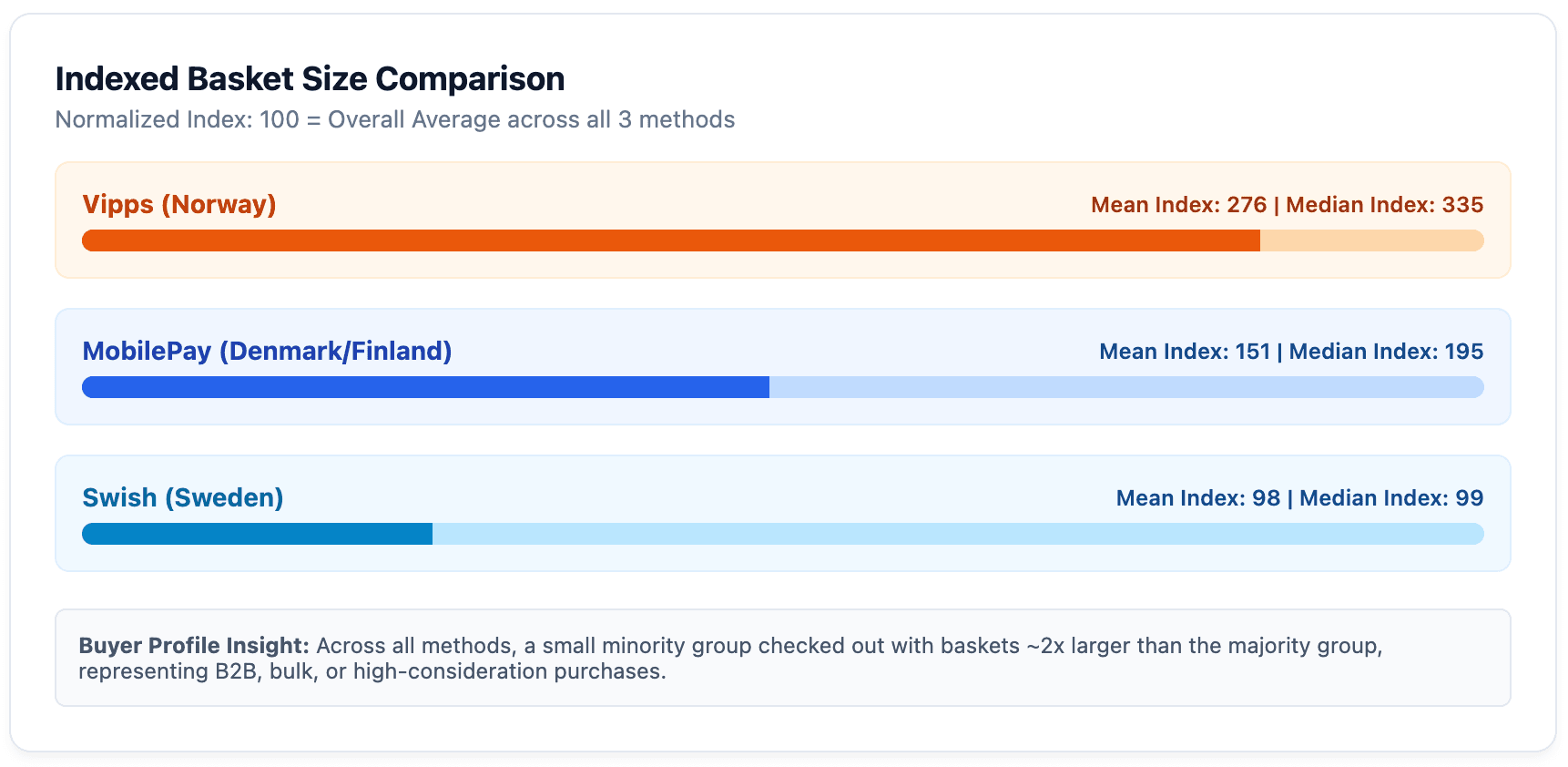
In plain terms, the typical Vipps basket in our data is more than three times the size of the typical Swish basket, and MobilePay sits solidly in between the two, closer to double Swish's basket size on a median basis.
We would not read too much into "which country spends more." A more likely explanation is category mix: Swish is deeply woven into everyday, lower ticket Swedish shopping, from groceries and fashion to smaller online orders, while the merchants and categories that lean on Vipps and MobilePay in our sample skew toward higher value purchases. This lines up with independent industry data on Vipps specifically, which has pointed to average Vipps transaction values running notably higher than debit card averages in Norway, a similar direction to what we see here, even if the exact ratio differs by source.
A second detail worth flagging: our data also carries a broad buyer type flag alongside country and payment method. Across all three methods, a small minority of sessions checked out with baskets roughly twice the size of the much larger majority group. We read this as most likely separating typical consumer purchases from larger, more considered orders, business buyers or bulk purchases being the obvious candidates, though our dataset does not let us confirm the exact driver with certainty. It is consistent enough across Swish, Vipps and MobilePay that it looks like a genuine buying pattern, not just noise from one merchant.
Across all three methods combined, checkout activity follows a familiar daily rhythm. Volume is lowest overnight, with the quiet stretch roughly between 2am and 5am local time accounting for well under 1% of the day's completed payments each hour. From around 8am things pick up steadily, holding fairly flat through the working day, before climbing to the day's clear peak in the early evening.
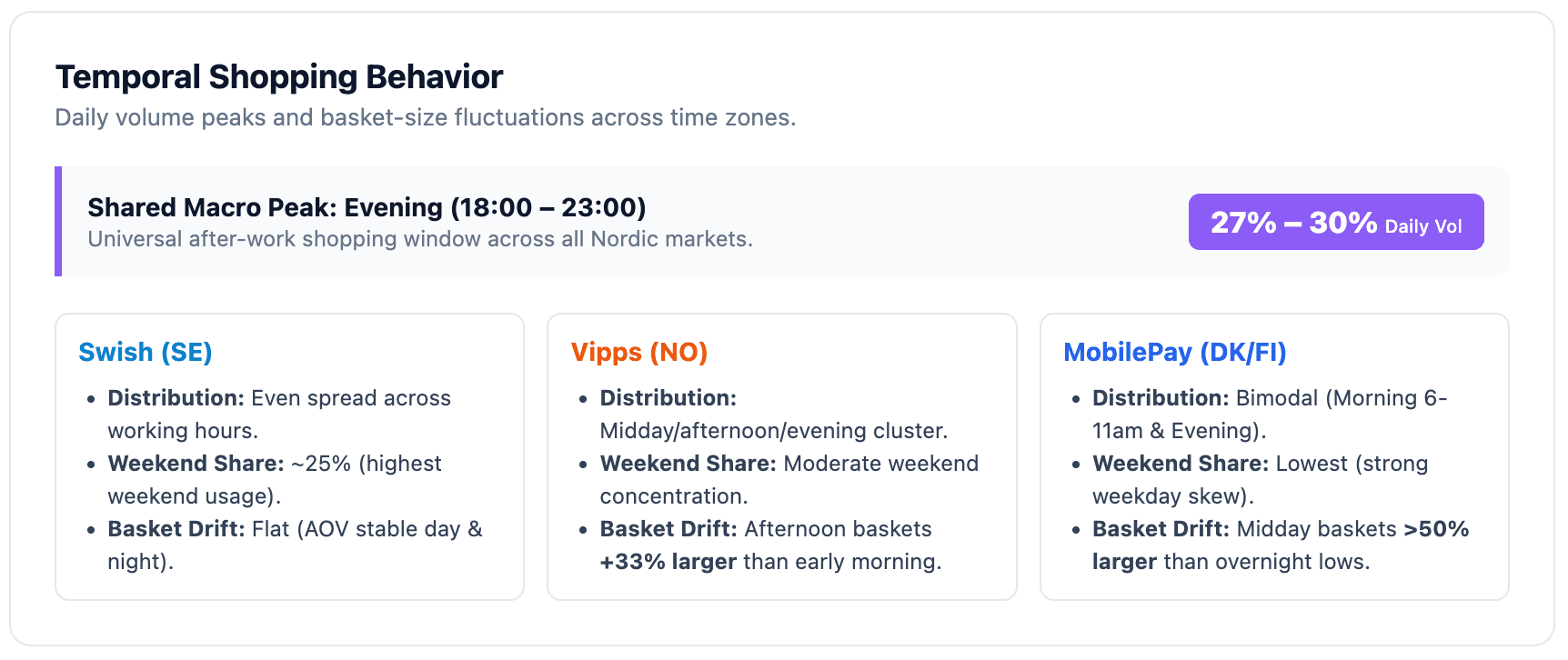
Evening, which we defined as 18:00 to 23:00 local time, is the single busiest window for every one of the three methods, accounting for roughly 27 to 30% of each method's daily volume. That is a reassuring, if unsurprising, finding for anyone building a checkout: the after work and after dinner window is when Nordic shoppers are most likely to be paying, not just browsing.
Underneath that shared pattern, the three methods diverge in some genuinely interesting ways:
Swish is the most evenly spread across the working day of the three, building gradually from morning through a broad midday and afternoon plateau before its evening peak. It is also the most weekend friendly of the three, with close to a quarter of its volume landing on Saturday or Sunday, noticeably higher than the other two.
Vipps leans slightly later in the day than Swish, with midday, afternoon and evening all sitting close together as its strongest windows, and a somewhat lower weekend share.
MobilePay shows the most distinctive shape. Its morning window (roughly 6am to 11am) is nearly as strong as its evening window, giving it a more bimodal, "before work and after work" pattern, and it is the most weekday-concentrated of the three, with the smallest share of weekend transactions. We also noticed a distinct spike in the late evening hour around 10pm. Given the smaller sample behind MobilePay in our data, we would treat that specific spike as an interesting signal to watch, not yet a firm conclusion.
Order value also shifts across the day, and not in the same way for every method. Swish is remarkably flat: its median basket size barely moves from morning to night, comfortably within a few percentage points across the entire day. That consistency fits a payment method that is used the same way whether someone is topping up a small order at 9am or 9pm. Vipps and MobilePay tell a different story. Both show noticeably larger baskets during the midday and afternoon hours than in the early morning or late night, with Vipps running roughly a third higher in the afternoon than first thing in the morning, and MobilePay showing an even larger swing, with midday and afternoon baskets running well over 50% above its overnight lows. That pattern is consistent with more considered, possibly desk-time purchases happening during the day, alongside the everyday evening browsing that drives the volume peak.
This pattern of an evening volume peak is not unique to the Nordics. Research into online shopping behaviour elsewhere in Europe has found a similar after-work shift, with UK and German shoppers concentrating online purchases from around 7pm onwards. What our data adds is that the same rhythm holds even for payment methods built specifically for fast, mobile-first, low-friction checkout, which suggests the evening peak is more about when people have time to shop generally than about any particular payment method's audience.
Everything above points to the same underlying conclusion the person asking for this analysis suspected going in: for e-commerce merchants selling into Sweden, Norway, Denmark or Finland, offering the relevant national mobile payment method is close to non-negotiable, and the reasons go well beyond our own dataset.
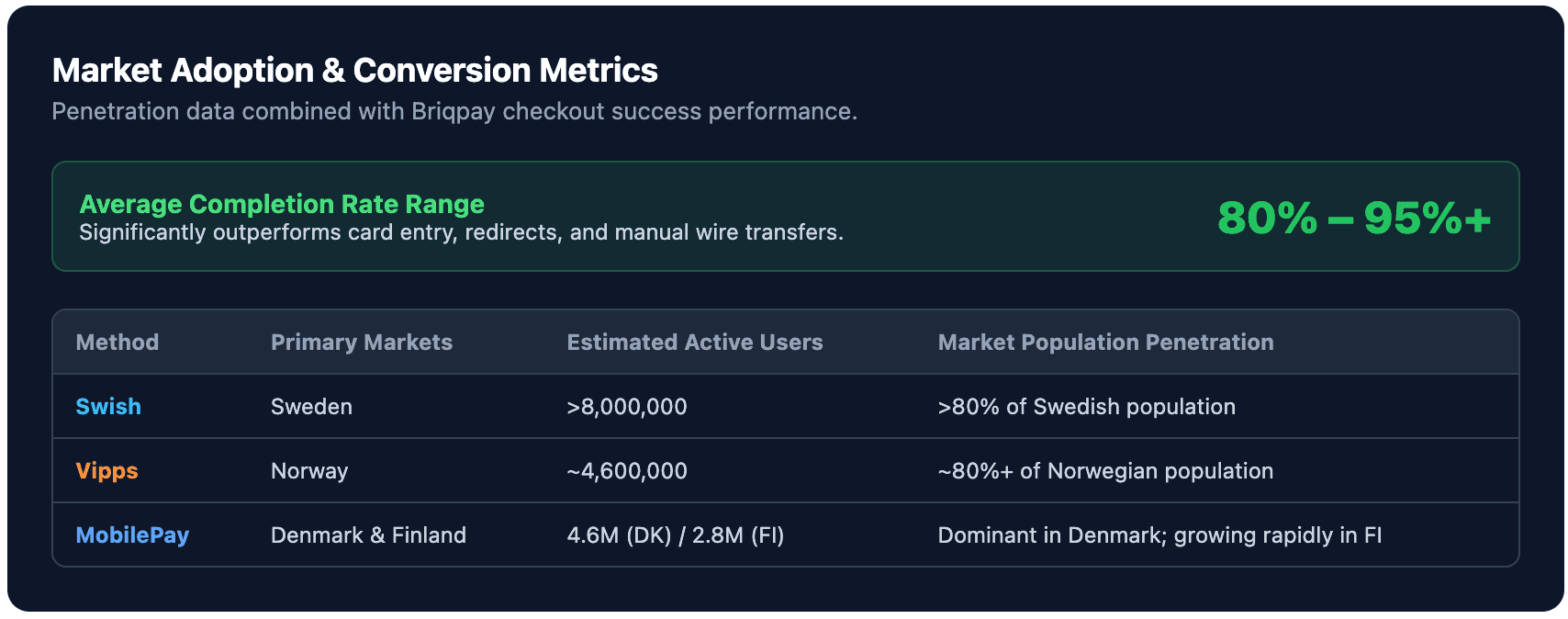
Adoption is the clearest argument. Independent reporting puts Swish at more than 8 million users, north of 80% of Sweden's roughly 10.2 million population. A joint Nordic central bank study published in late 2025 put Vipps at around 4.6 million users in Norway and MobilePay at around 4.6 million in Denmark and 2.8 million in Finland, all in markets with populations between roughly 5 and 6 million each. Combined across its two apps and four markets, Vipps MobilePay describes itself as trusted by over 12 million people across the Nordics. Very few payment methods anywhere reach penetration like that.
Our own data backs this up from the completion side too. Across Swish, Vipps and MobilePay, the share of attempted payments that finished successfully sat consistently in a strong 80 to 95%+ range, comfortably ahead of what most checkouts see from payment methods that still require typing in card details, a device redirect, or a manual bank transfer.
But the more useful takeaway for merchants is not that these three methods are interchangeable "must haves." It is that they clearly serve different moments in the shopper's day and different sizes of purchase. Swish looks like a payment method for everyday, any time of day, any day of the week shopping. Vipps and MobilePay look more skewed toward considered, higher value purchases concentrated in the working day and evening. A merchant selling across all four Nordic markets is not just adding checkout options by supporting all three, they are matching the payment experience to genuinely different buying behaviour in each market.
This analysis is based on aggregated, anonymised checkout session data covering the past 12 months across our merchant network. Processor variants of the same underlying method (for example different PSP integrations of Swish, or of Vipps) were combined into a single method before any comparison was made. Average order value figures are presented as an index, with 100 set as the overall average across all three methods, instead of as absolute currency figures, since converting across Swedish, Norwegian, Danish and Finnish currencies into one comparable figure necessarily involves a normalisation step, and we wanted the comparison to be about relative scale, not a specific number in a specific currency. Time-of-day figures are based on each transaction's local time in its home market. Because the underlying volume behind Swish is substantially larger than behind Vipps or MobilePay in our sample, we have flagged the smaller-sample findings as directional throughout, not given equal statistical weight to all three. No individual, order or merchant can be identified from any figure in this piece.
These Nordic order value and shopping time patterns line up with the broader case made in what actually reduces checkout costs and cart abandonment: payment mix drives both cost and conversion.
Card payments acquired in the shopper's own country are approved more often, and between the UK and the EU they can cost five times less. What local acquiring is, what it saves and how to set it up across the Nordics.
CCD2 brings buy now pay later and invoice under consumer credit law on 20 November 2026. What changes at checkout, which countries are ready (the Netherlands and Norway are not), and how exposed each market is, with our own checkout data.
Last year the Black Friday peak started two weeks before Black Week and ran into mid December, and this year a new credit law lands in the middle of it. A week-by-week payment plan built on our 2025 checkout data.
Connect any payment provider. Optimize your payment flow. Scale without limitations - with Briqpay’s Payment Integration Platform.
