
More insights

Co-founder, Chief Executive Officer
September 28, 2026 at 07:00 AM
 On 20 November 2026 the EU's revised Consumer Credit Directive, CCD2, starts to apply. For most of the last fifteen years, buy now pay later and short interest-free invoice payments sat outside consumer credit law in Europe. From that date they sit inside it, in every country that has transposed the directive on time.
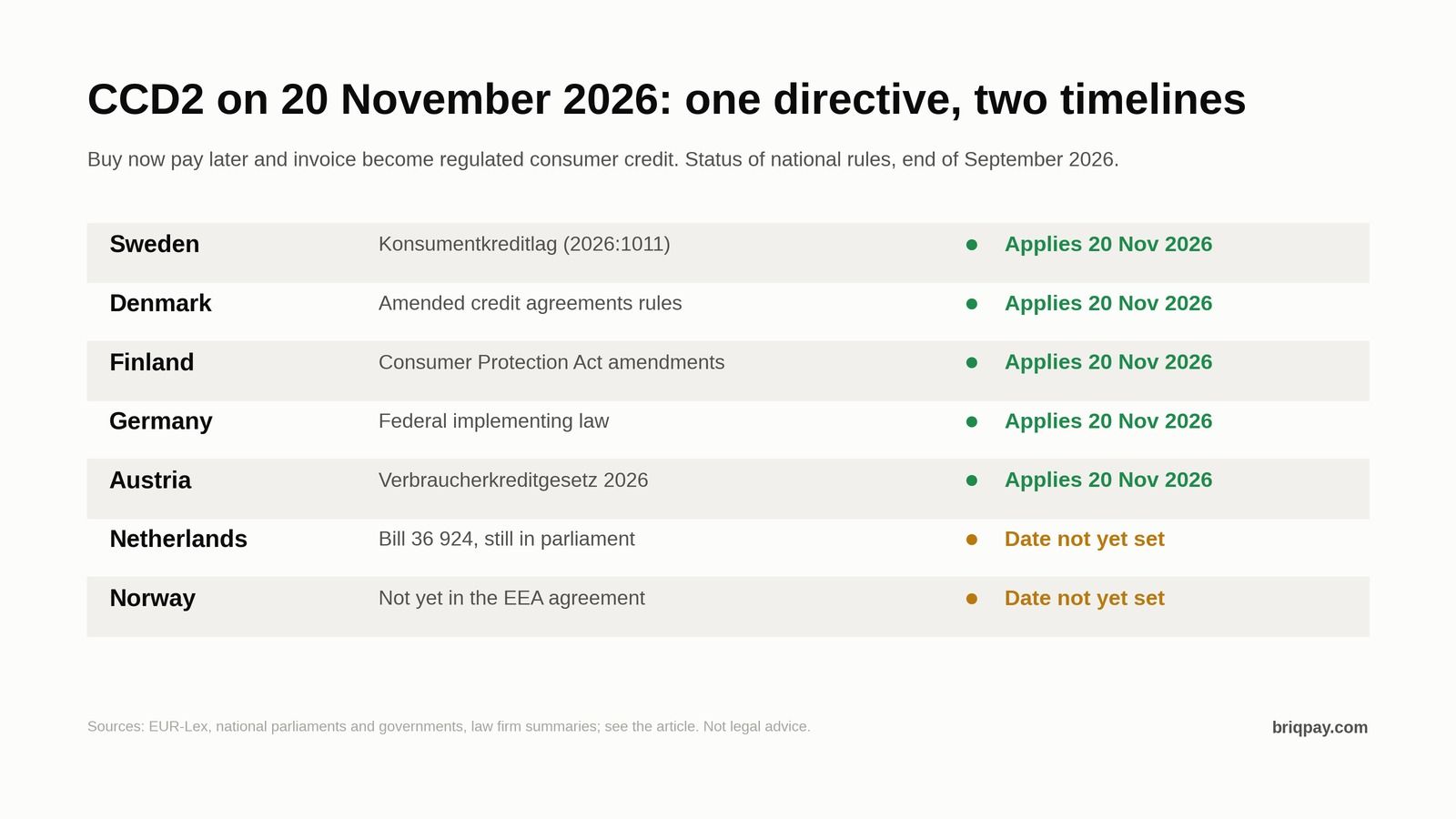
That last condition matters more than most merchants realise. Sweden, Denmark, Finland, Germany and Austria have their national laws in place for 20 November. The Netherlands does not yet, and Norway is not bound by the directive at all until it enters the EEA agreement. A merchant who sells across the Nordics and Northern Europe is dealing with one directive, several national laws and at least two different timelines.
This guide covers what CCD2 is, what it changes at the checkout, where each country stands at the end of September 2026, and how exposed each market is, using our own consumer checkout data.
CCD2 is Directive (EU) 2023/2225 on credit agreements for consumers. It replaces the 2008 Consumer Credit Directive, which was written before smartphones, instant credit decisions and pay later buttons existed. Member states had until 20 November 2025 to write it into national law, and the new rules apply from 20 November 2026.
Three changes define it for e-commerce:
What stays exempt. The directive keeps one narrow exemption: a deferred payment granted by the seller itself, with no interest and no charges other than limited late-payment fees, where the price is paid within 50 days of delivery. For large sellers the window is 14 days. The German, Dutch and Finnish implementations all use this 50 and 14 day structure, as explained by A&O Shearman for Germany and CMS for the Netherlands. Once a third party provides the credit, or the receivable is sold on to a financing company in the usual factoring model, the exemption generally no longer applies.
What the provider must do. For every in-scope credit purchase, regardless of amount, the provider must assess creditworthiness using information about the consumer's income, expenses and financial situation. Where that assessment is automated, consumers get the right to ask for a human review. The provider must give standardised pre-contract information, the Standard European Consumer Credit Information form, before the consumer is bound, and the consumer has a 14-day right of withdrawal.
What the merchant must do. Even if you are not the creditor, the checkout is yours, and several rules land on it directly:
Status at the end of September 2026, based on the sources linked below.
| Country | National law | Applies from | Status |
|---|---|---|---|
| Sweden | New Konsumentkreditlag (2026:1011) | 20 Nov 2026 | Adopted. Existing providers have until 20 Nov 2027 to be authorised |
| Denmark | Amended credit agreements rules | 20 Nov 2026 | Adopted. Merchants offering credit need Finanstilsynet approval |
| Finland | Consumer Protection Act amendments (HE 120/2025) | 20 Nov 2026 | Adopted. Distance selling parts applied from 19 Jun 2026 |
| Germany | Federal implementing law | 20 Nov 2026 | Passed by the Bundestag in April 2026 and approved by the Bundesrat |
| Austria | Verbraucherkreditgesetz 2026 | 20 Nov 2026 | Passed by the Nationalrat on 21 May 2026 |
| Netherlands | Implementation bill 36 924 | Not yet set | Still before the Tweede Kamer |
| Norway | None yet | Not yet set | Directive not yet part of the EEA agreement |
Sweden has the most detailed rulebook and the largest exposure. The new Konsumentkreditlag replaces the old act on 20 November, and every provider offering consumer credit falls under Finansinspektionen's authorisation regime. We have covered it in depth in the ultimate guide to CCD2 and Sweden's new Consumer Credit Act and what changed when the law passed.
Denmark applies the directive on the same date. The detail that matters for merchants: the exemption for a seller's own interest-free payment terms shrinks from 90 days to 50, and companies offering credit to consumers must apply to Finanstilsynet for approval by 20 November, as Dansk Erhverv explains. Our CCD2 Denmark guide covers the rest.
Finland implemented the directive through amendments to the Consumer Protection Act and a new act on credit intermediaries. Interest-free payment deferrals are now consumer credit unless they meet the 50 or 14 day exemption, and web shops must show the standardised information and the borrowing warning, according to Dittmar & Indrenius. For the wider Finnish payment picture, see our guide to payment gateways in Finland.
Germany passed its implementing law in April 2026. The Federal Government's summary confirms that small loans under EUR 200, interest-free credit, credit with terms under three months and buy now pay later models are now covered, and that consumers get a right to human review of automated credit decisions. Germany is invoice country: a merchant's own Rechnungskauf can stay outside the rules within the 50 or 14 day limits, while invoice run through a financing provider is in scope.
Austria rewrote its consumer credit law completely. The Austrian Parliament passed the Verbraucherkreditgesetz 2026 on 21 May, bringing payment deferrals and BNPL into scope and removing the EUR 200 threshold, and it replaces the 2010 act on 20 November 2026, according to CHG Czernich.
The Netherlands is the outlier. The Dutch implementation bill was sent to parliament on 1 April 2026 and, at the end of September, was still at committee stage in the Tweede Kamer, with a legislative consultation scheduled for 28 September and fresh amendments filed, including one on an age limit for buy now pay later (bill 36 924 on the Tweede Kamer site). Both chambers still have to vote, so the Dutch rules are unlikely to apply on 20 November. When they do, most BNPL providers will need a licence from the AFM.
Norway is not an EU member, and the directive has not yet been incorporated into the EEA agreement, according to the Norwegian government's EEA notes. Norwegian checkouts keep the current rules for now.
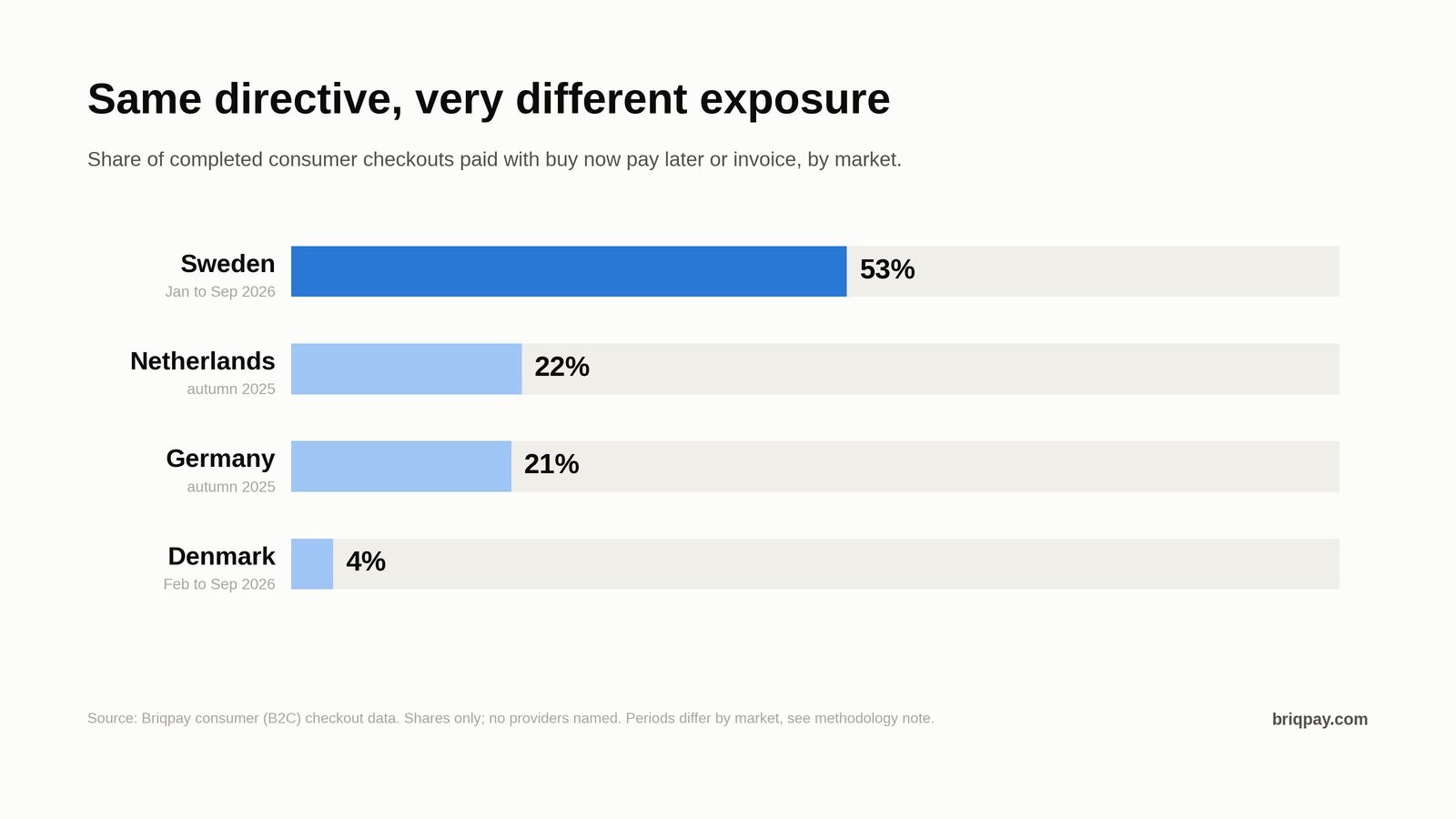
The legal status tells you when the rules change. It does not tell you how much of your checkout they touch. For that we looked at completed consumer checkouts on our platform and measured the share paid with buy now pay later or invoice, the two categories that count as consumer credit under CCD2 when a provider stands behind them.
| Market | BNPL + invoice share of consumer checkouts | Black Friday weekend 2025 | CCD2 applies |
|---|---|---|---|
| Sweden | 53% (Jan to Sep 2026) | 51% | 20 Nov 2026 |
| Netherlands | 22% (autumn 2025) | 27% | Not yet set |
| Germany | 21% (autumn 2025) | 20% | 20 Nov 2026 |
| Denmark | 4% (Feb to Sep 2026) | Too small to report | 20 Nov 2026 |
Four things stand out.
Sweden is in a category of its own. More than half of Swedish consumer purchases on our platform are credit agreements in the eyes of the new law. We broke that number down in our September data update: it did not move when most standalone credit institutions left the Swedish market in July, because the providers behind the pay later button were never the ones affected.
The Netherlands has real exposure and the least certainty. More than one in five Dutch consumer checkouts is BNPL or invoice, and the share rose by five points on the Black Friday weekend as shoppers spread the cost of discounted purchases. A merchant selling into the Netherlands has to plan for the new rules arriving after peak season, possibly with an age limit for BNPL that no other market has.
Germany's exposure is mostly invoice. Invoice alone was 13% of German consumer checkouts in our autumn 2025 baseline, BNPL 8%. That puts the 50 and 14 day exemption at the centre of every German checkout review: the question is not only whether your providers are compliant, but whether your own payment terms still sit outside the rules.
Denmark is a card market. Credit is a small slice of Danish checkout, so the directive is a narrow compliance project there. The approval requirement for merchants that extend credit themselves is the part to check.
Black Friday 2026 is 27 November, seven days after the rules apply in Sweden, Denmark, Finland, Germany and Austria. Last year the Black Friday weekend ran at up to nine times a normal day, with Swedish and Dutch shoppers moving toward BNPL. We have covered what last year's data means for this year in Black Friday 2026 checkout prep, and turned it into a week-by-week Black Friday 2026 checklist.
The practical point for CCD2: the rules change during the ramp-up, not before it. A merchant who needs to swap or add a credit provider in the week of 20 November will be doing it while traffic is already at two to three times normal. That is much easier when adding, removing or reordering a payment method is configuration rather than a development project, which is what a payment orchestration layer is for.
Methodology note: Checkout figures are drawn from Briqpay's own consumer (B2C) checkout data, covering completed checkouts with internal test transactions excluded. Sweden covers January to September 2026 and Denmark February to September 2026. Germany and the Netherlands use the autumn 2025 baseline (1 October to 9 November 2025) from our Black Friday analysis; the Black Friday weekend is 28 November to 1 December 2025. Payment methods are grouped by category (card, wallet, bank transfer, invoice, buy now pay later, mobile payment); we do not name individual providers and we report shares, not volumes. The merchant base changes over time, so comparisons between periods are indicative. Legal status reflects public sources at the end of September 2026 and is not legal advice; check the rules for your own business with a lawyer in each market.
Last year the Black Friday peak started two weeks before Black Week and ran into mid December, and this year a new credit law lands in the middle of it. A week-by-week payment plan built on our 2025 checkout data.
Our own checkout data, January to September 2026: buy now pay later and invoice carry 53% of Swedish consumer checkouts and 4% of Danish ones, and the July shakeout of credit institutions changed nothing at the checkout. Here is what CCD2 actually touches on 20 November, and why Black Friday multiplies it.
A complete guide to payment gateways in Finland: Paytrail, MobilePay, cards, and B2B invoicing, and how to connect them all through one integration.
Connect any payment provider. Optimize your payment flow. Scale without limitations - with Briqpay’s Payment Integration Platform.
