
More insights

Co-founder Briqpay
September 23, 2026 at 07:00 AM
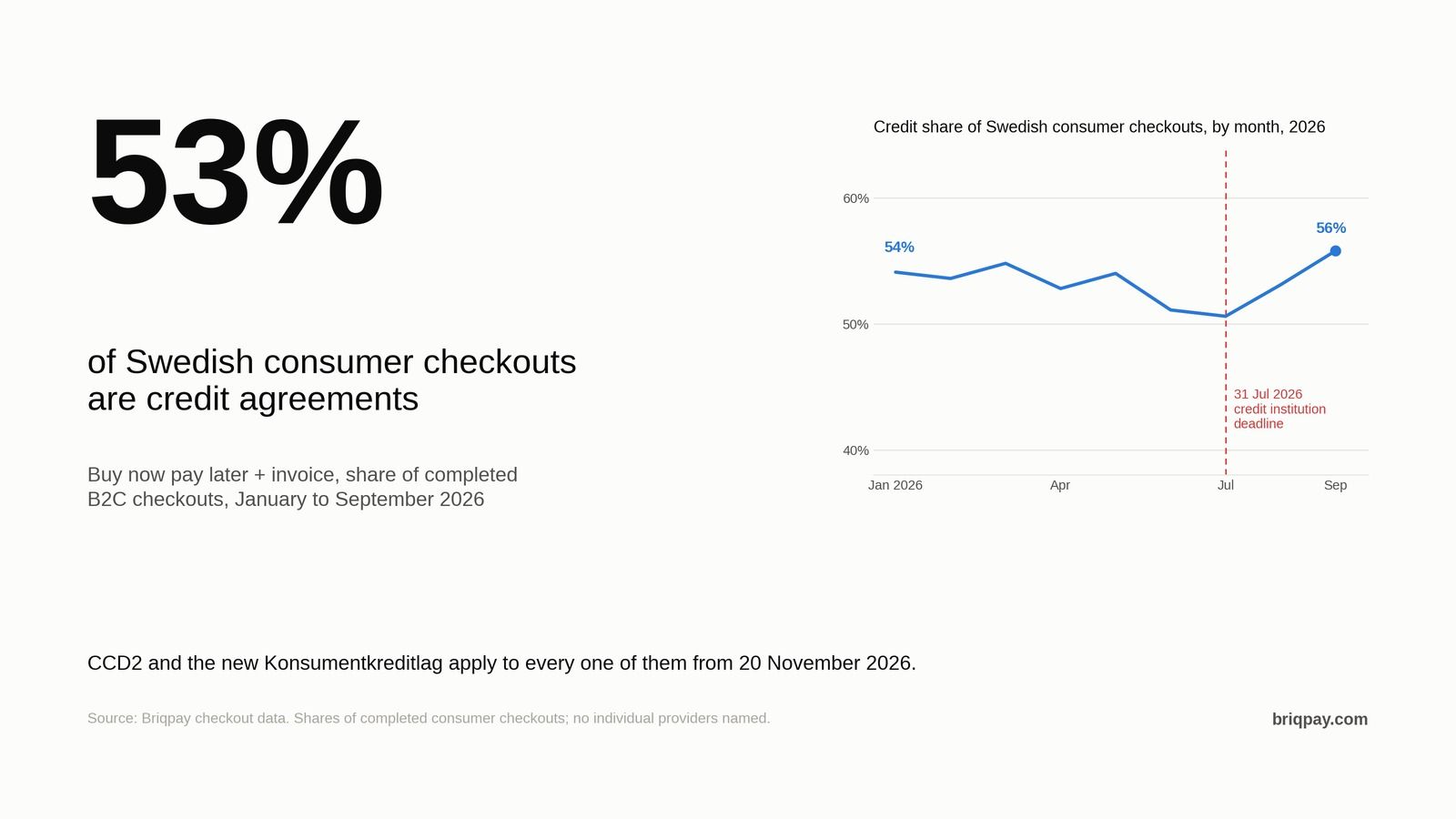
On 20 November 2026, Sweden's new Konsumentkreditlag (2026:1011) starts to apply, and with it the EU's revised Consumer Credit Directive, CCD2. We have written about what the law says, what changed when it passed and how the July shakeout of credit institutions played out. This time we went to our own checkout data and asked a simpler question: how much of the Swedish consumer checkout does this law actually touch, today, eight weeks out?
The answer is 53%.
We looked at completed consumer (B2C) checkouts across the Swedish merchants on our platform from January to September 2026, grouped by payment category: card, wallet, mobile payment, bank transfer, invoice and buy now pay later. Invoice and buy now pay later are the two categories that count as consumer credit under the new law. We do not name individual providers, and we report shares rather than volumes.
Across those nine months, buy now pay later accounted for roughly 50% of completed Swedish consumer checkouts and invoice for a further 3 to 4%. Mobile payment took about 30%, and card and wallet together about 16%.
So for a typical Swedish webshop selling to consumers, slightly more than one in two completed purchases is a credit agreement in the eyes of CCD2. Every one of those checkouts is subject to the new creditworthiness assessment, the pre-contract information requirements and the rules on how the credit option may be presented, from 20 November.
In our September update we treated the 31 July 2026 deadline for standalone consumer credit institutions as a dress rehearsal for CCD2 enforcement: roughly 50 companies affected, 17 applications filed with Finansinspektionen, one approval by the deadline, and a clear majority choosing to leave the regulated market.
If that shakeout had reached the checkout, we would expect to see it in the payment mix. We do not.
| Period (Swedish consumer checkouts) | BNPL + invoice share |
|---|---|
| Q4 2025 | 50% |
| January to June 2026 | 53% |
| July 2026 | 51% |
| August to 22 September 2026 | 54% |
Credit's share of the Swedish consumer checkout is the same after 31 July as it was before. Buy now pay later alone was 50.0% in the first half of the year and 50.3% in August and September; invoice moved from 3.4% to 3.9%.
The reason is straightforward once you look at who was affected. The July rule applied to companies whose only business was granting or brokering consumer credit. The credit that runs through Swedish e-commerce checkouts is overwhelmingly provided by banks and credit market companies that were never in that bucket. The market that thinned out in July was the market for standalone loans and loan brokering, not the buy now pay later button in your checkout.
That is the uncomfortable part. The July deadline tested a different set of companies than the ones your checkout depends on. The 20 November deadline is the first one that applies to all of them at once. Under the new law, everyone offering consumer credit at checkout falls under the same regime and needs Finansinspektionen's authorisation; existing providers have until 20 November 2027 to have it approved, but the conduct rules, the assessment and the disclosure requirements apply to every credit checkout from 20 November this year. Finansinspektionen has already started contacting companies about the stricter consumer credit rules and has proposed new regulations and general guidelines on consumer credit to go with the law.
Denmark applies CCD2 on the same day, and we have covered how its implementation differs. Our checkout data shows why the conversation in the two countries should be different too.
In Danish consumer checkouts on our platform between February and September 2026, buy now pay later and invoice together made up about 4% of completed purchases. Card and wallet made up 84%.
| Consumer checkouts, 2026 | Sweden | Denmark |
|---|---|---|
| BNPL + invoice | 53% | 4% |
| Card + wallet | 16% | 84% |
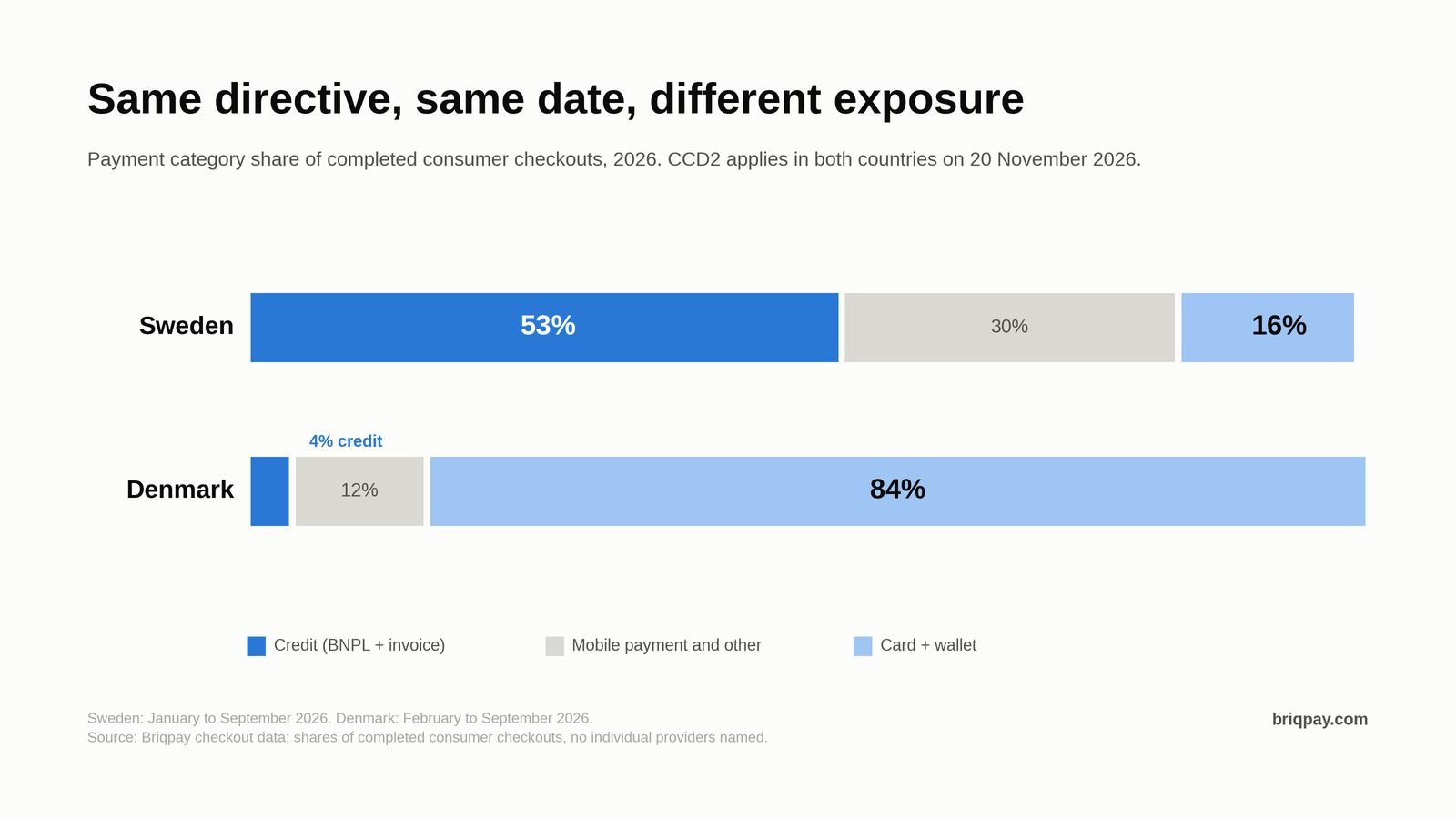
For a Danish merchant, CCD2 is a compliance project on a small slice of checkout. For a Swedish merchant it is a rule change on the majority of it. A merchant selling into both cannot run one plan.
Black Friday 2026 is 27 November, seven days after the law applies. In our analysis of Black Friday 2025, Swedish consumers moved toward credit on the peak weekend: buy now pay later and invoice reached 51% of completed checkouts, against a baseline of about 46% in the weeks before.
The baseline has moved since then. Credit already carries 53 to 54% of Swedish consumer checkouts on an ordinary day in 2026. If the same Black Friday lift repeats, close to three in five Swedish consumer purchases on the first Black Friday under CCD2 will be credit agreements assessed and presented under rules that will have been live for one week.
The data does not change the checklist we published in the CCD2 guide, but it changes the weight behind three items on it.
Do not read July as reassurance. If your buy now pay later and invoice providers came through the summer untouched, that is because the July rule was not aimed at them. Ask each one, in writing, where it stands on authorisation under the new Konsumentkreditlag and whether its checkout flow will meet the assessment and information requirements on 20 November. The licence categories are described on Finansinspektionen's site.
Plan for more declines on the method half your customers choose. A full creditworthiness assessment on every credit purchase, regardless of amount, means more shoppers will be told no, and a different group of shoppers than most checkout teams plan for. What the shopper sees in the seconds after a decline, and whether a non-credit method is one tap away, now decides the outcome of a majority of your Swedish checkouts, not a minority. Our earlier work on what actually reduces checkout costs and cart abandonment covers the retry mechanics.
Treat the credit slot as infrastructure, not a plugin. With one provider carrying half your consumer checkout, a licensing delay, a flow change or an outage on that provider in the week of 20 November is not an edge case, it is your conversion rate. A second compliant credit provider you can switch on by configuration, and a clear fallback to mobile payment or card, is the difference between a rule change and a lost Black Friday. Our post on why payment preference, not speed, decides checkout conversion makes the wider case.
The directive itself, for reference, is Directive (EU) 2023/2225 on EUR-Lex. The Swedish law is Konsumentkreditlag (2026:1011), applying from 20 November 2026.
Eight weeks is enough time to confirm every provider's status, test the new flows on real traffic in early November and rehearse the decline case. It is not enough time to start in November.
Methodology note: Figures are drawn from Briqpay's own consumer (B2C) checkout data for merchants selling in Sweden and Denmark, covering completed checkouts from 1 January to 22 September 2026 with internal test transactions excluded (Q4 2025 shown for comparison). Payment methods are grouped by category (card, wallet, mobile payment, bank transfer, invoice, buy now pay later); we do not name individual providers and we report shares, not volumes. The merchant base on the platform changes over time, so month to month comparisons are indicative rather than a controlled study. Black Friday 2025 figures are from our earlier analysis and use the same definitions.
A complete guide to payment gateways in Finland: Paytrail, MobilePay, cards, and B2B invoicing, and how to connect them all through one integration.
Black Friday 2026 lands seven days after CCD2 applies. We went back to our consumer checkout data from Black Friday 2025: a peak nine times a normal day, BNPL up six points in Sweden and the Netherlands, and a busiest hour of 22:00. Here is what to fix first.
commercetools makes best-of-breed payments possible but not automatic. Here is how payments grow connector by connector, what Connect and Checkout give you, and how an orchestration layer lets you add providers by market and customer type without new builds.
Connect any payment provider. Optimize your payment flow. Scale without limitations - with Briqpay’s Payment Integration Platform.
