
More insights

Co-founder Briqpay
November 18, 2026 at 08:00 AM
This is the third and last post in our weekly series before Black Week. We started with November as a whole, and last week we showed that Black Friday is the loudest day but not where most of the money goes. This week we look at how last year's sale actually turned out, and at the rules that apply to this year's campaign before Black Week starts on Monday 23 November (Mobilmarket's Black Week 2026 calendar).
Ahead of Black Week 2025, Svensk Handel forecast sales of SEK 10.2 billion, up from SEK 9.7 billion in 2024 (EFN, 20 November 2025). Its follow-up after the sale told a different story. Compared with the same day the year before, Black Friday sales fell 7%. Across the whole of Black Week the decline was milder, at 2%. Fashion was the strongest category with growth of 1%, and beauty fell the most, by 6% (Svensk Handel, 3 December 2025).
The same follow-up shows why. Just over 22% of the consumers in Svensk Handel's study made at least one purchase during Black Week, down from nearly 25% the year before. Those who did buy spent on average 5% more each. November as a whole still grew.
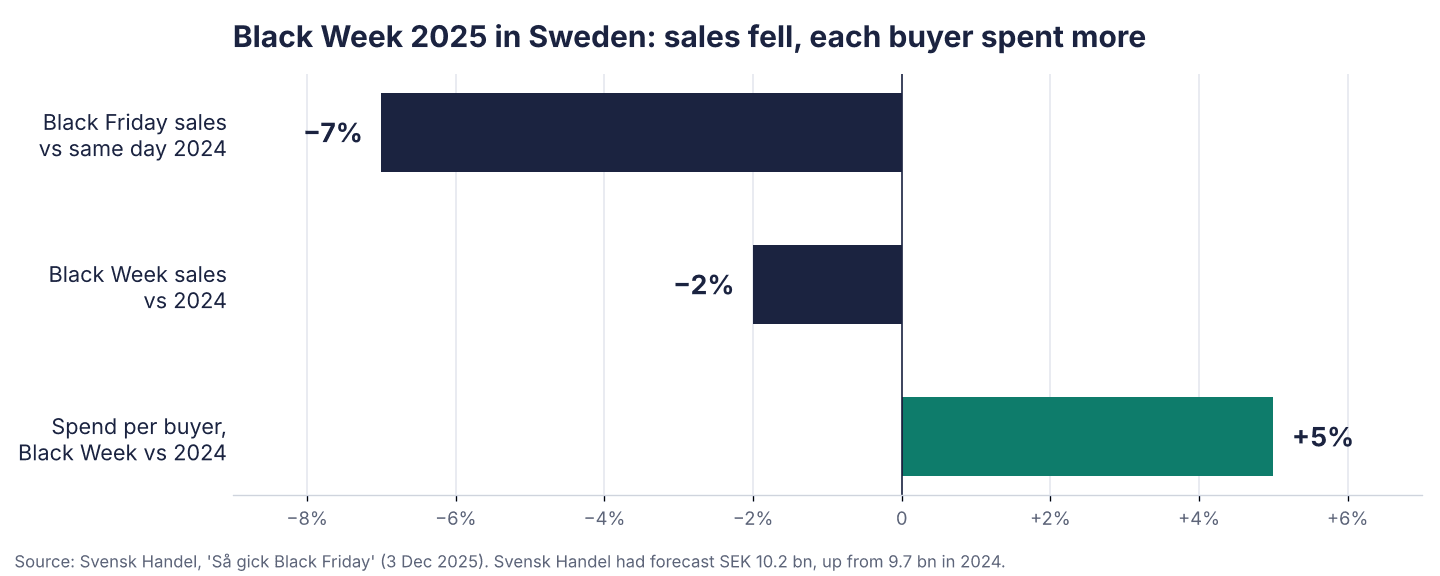
Svea Bank's statistics on comparable e-retailers, reported by Ehandel.se, point the same way from the payments side: Black Friday 2025 turnover was down about 3.4%, transactions down about 17% and average order value up about 16%. The two sources measure different things, but the pattern is the same. Fewer people bought, and each order was bigger.
For a checkout, that changes what a lost order costs. When there are fewer orders and each one is worth more, a shopper who gives up at the payment step takes more revenue with them than on an ordinary day. Conversion at checkout matters more than the traffic forecast.
Forecasts for 2026 point up again, at least in the US. Adobe expects US online sales on Black Friday of USD 12.9 billion, up 9.2%, and USD 15.1 billion on Cyber Monday, up 6.2%. It expects buy now pay later to account for USD 21.3 billion of online holiday sales, up 6.6%, and mobile to make up 57.4% of online sales over the season (Digital Commerce 360 on Adobe's forecast).
Sweden is not the US, and last year showed how far a forecast and an outcome can drift apart. Svensk Handel had not published its 2026 Black Week forecast when this post was written. Whatever it says, it is safer to plan the checkout for the shape of last year's sale, with fewer and larger orders, than for the headline number.
When a product is marketed as reduced, the Swedish price information act requires the earlier price to be shown, and that price must be the lowest price the trader applied in the 30 days before the reduction. If the price was cut in steps, the price before the first cut applies (Prisinformationslagen 7 a §).
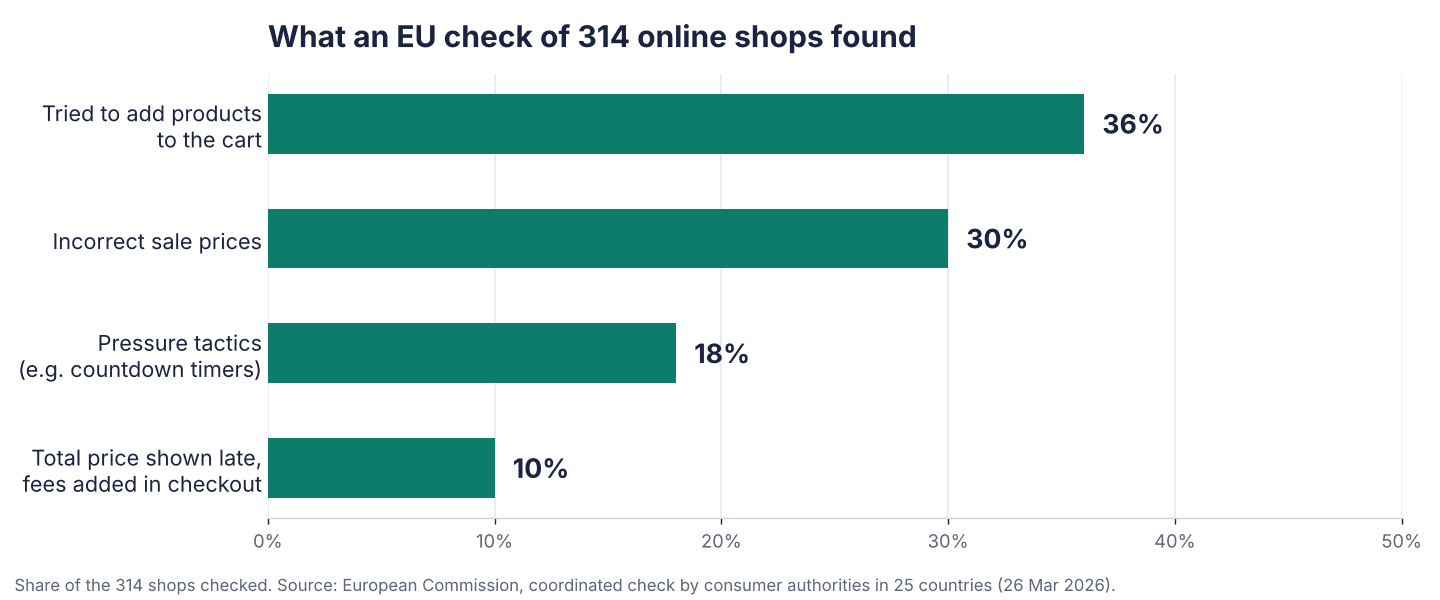
The rule is enforced. Konsumentverket told TT that in its review last year, 39% of the companies it checked broke the price information act, most often by showing the wrong reference price (TV4/TT, 8 November 2026). An EU-wide check of 314 online shops, coordinated by the European Commission and published in March 2026, found incorrect sale prices on 30% of them (European Commission).
The same EU check found problems that sit inside the checkout itself. 10% of the shops did not show the total price up front and added delivery or service fees late in the checkout. 36% tried to add products to the shopping cart, and 40% of those did it without asking. 18% used pressure tactics such as claiming a product was nearly sold out or showing a countdown timer, and more than half of those cases were misleading. On a day when shoppers are already wary of offers, a checkout that holds back the total or adds items without asking gives them a reason to leave.
The new Swedish consumer credit act enters into force this Friday, three days before Black Week (SFS 2026:1011). Three parts of it touch the checkout directly. The text below follows the government bill, prop. 2025/26:223.
First, a consumer is bound by a credit agreement only if they have expressly agreed to enter into it (chapter 4, section 1). Second, the lender must assess whether the consumer can afford the credit, and may grant it only if they can (chapter 3, section 13). As Dagens PS reported, that now includes small purchases on invoice and instalments through payment companies.
Third, and easy to miss: a merchant's own invoice is only outside the act if it carries no credit costs and is paid within 50 days of delivery. For an online sale where the seller is not a smaller company, the limit is 14 days, and the invoice may not be sold on while it runs (chapter 1, section 3). If you offer your own invoice online with longer terms, check with your legal adviser now whether it falls under the act from Friday.
Credit agreements made before 20 November stay under the old rules. Every order on credit during Black Week falls under the new ones. For the background, see the ultimate guide to CCD2 and our country-by-country update.
Run a full test purchase with every payment method in the checkout, on a phone as well as a desktop, after the last campaign changes have gone live. From Friday, include a credit application that is declined, and check that the shopper is offered another way to pay rather than an error.
Check that the total price, including delivery and any fees, is visible before the final step, and that nothing is added to the cart without the shopper choosing it. Check that every reduced price shows the lowest price from the past 30 days.
Ask each payment provider to confirm in writing that its flow meets the new credit rules from 20 November, and that its capacity is planned for peak volume. On our data, last year's Black Friday ran at about nine times a normal autumn day and the Sunday after at about seven times (the Black Friday weekend post).
Finally, set a baseline. Note approval rates and conversion by payment method for the days before Friday, so that a change during the sale can be traced to the new rules, the campaign or a provider. If you started from our eight-week checklist, this is its last step.
Black Week starts on Monday. We will come back after the sale with what the numbers showed.
Methodology note: Black Week dates are from Mobilmarket's retail calendar. Svensk Handel's 2025 forecast is as reported by EFN on 20 November 2025, and its results are from its own follow-up published on 3 December 2025, which does not state its sample or method. Svea Bank figures are year-on-year changes for comparable e-retailers, as reported by Ehandel.se. Adobe's forecast covers US online sales and is as reported by Digital Commerce 360 on 29 September 2026. Konsumentverket's review figure is as quoted by TT on 8 November 2026. The EU figures are from the European Commission's coordinated check of 314 online shops, published on 26 March 2026. Legal references follow the text of the government bill; check the final wording in SFS 2026:1011. Briqpay figures are completed consumer (B2C) checkouts. This is not legal advice, and we do not name individual providers.
Black Friday is the biggest day of Black Week, but about two thirds of the extra spending lands on the other six days. What that means for your checkout, and for CCD2 from 20 November.
Black Week runs 23 to 29 November and Black Friday is on the 27th, but in most checkouts the whole month is the peak. Last year's Black Month data, what the new consumer credit act changes from 20 November, and what to settle before the sale starts.
Five weeks before CCD2 applies, five EU markets have a law and a date. The Netherlands does not. Where each country stands, how much credit each checkout carries, and what to check this week.
Connect any payment provider. Optimize your payment flow. Scale without limitations - with Briqpay’s Payment Integration Platform.
