
More insights

Co-founder Briqpay
August 7, 2026 at 07:00 AM
At Briqpay we sit in the middle of a lot of checkouts, which means we also see what happens the moment a payment does not go through. Most conversations about checkout focus on conversion rate or the initial choice of payment method. Far less has been written about the second choice: what a shopper actually does after their first attempt fails.
We analysed a full year of checkout session data, more than 31,500 recorded retries across our merchant network, where a shopper's first payment attempt failed and they went on to complete the purchase with a different method. For each session we know which payment method and category failed (card, wallet, BNPL, invoice, mobile payment or bank transfer), and which method and category the shopper ultimately succeeded with. No merchant names, customer details or order values are part of this analysis. It is aggregated behavioural data only, and every method mentioned below is discussed purely in terms of how shoppers route around a failure, not as a judgement on the method itself. A failed attempt can happen for many mundane reasons (insufficient funds, a 3D Secure timeout, a bank's fraud filter, a typo), and none of that is a reflection of the payment method's quality.
One honest limitation up front: this dataset only contains shoppers who came back and paid successfully. It says nothing about the (likely larger) group who failed once and simply left. So think of this as a study of successful recovery behaviour, not a study of overall failure rates.
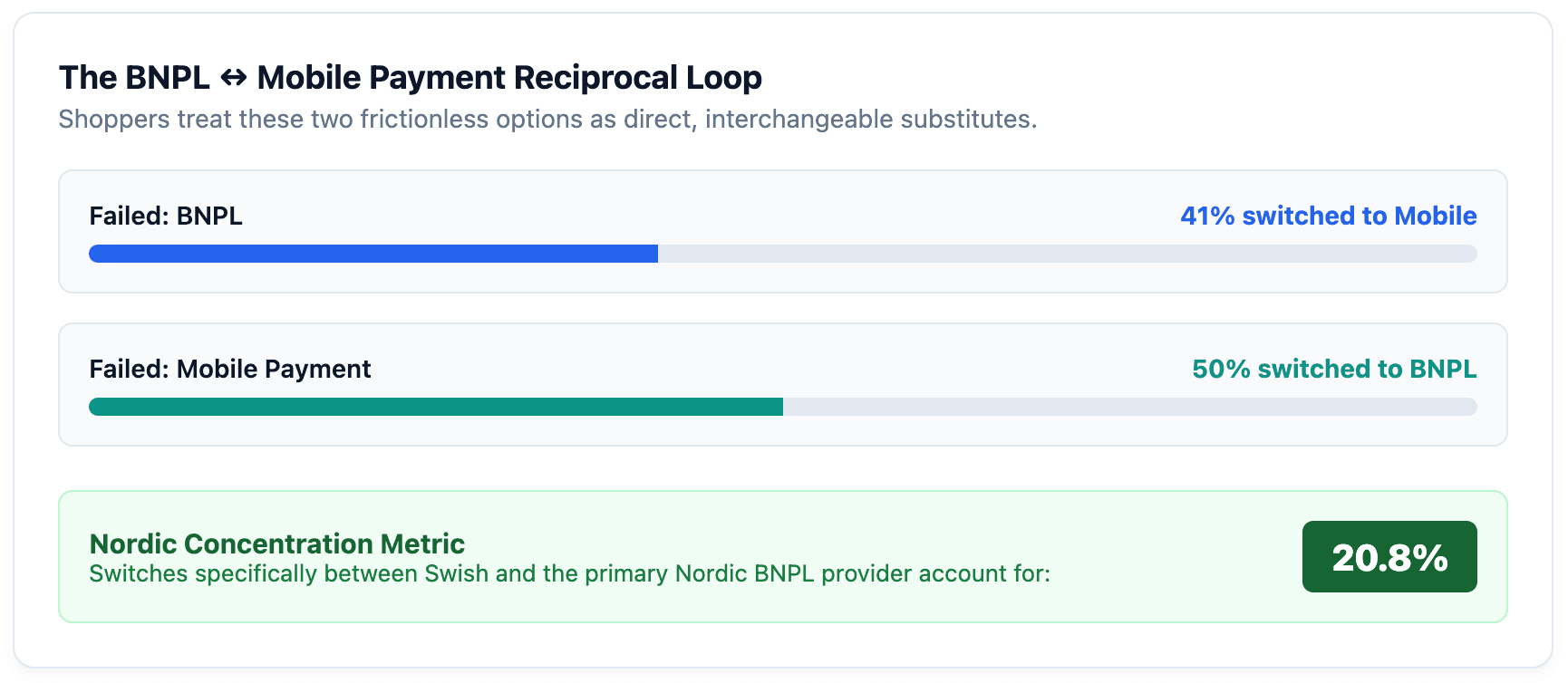
The single biggest flow in the entire dataset is a loop between two categories: buy now, pay later (BNPL) and mobile payment apps.
That is a striking concentration for two payment methods to produce out of dozens available. Our reading, and this is an interpretation rather than something the data proves directly, is that in markets where both a strong BNPL option and a fast mobile payment app are available, shoppers treat them as close substitutes for the same underlying need: a way to pay without typing in a full card number. When one is briefly unavailable, be it a declined credit check, a session timeout or a technical hiccup, the shopper does not go looking for a third option. They reach for the other "easy" one.
Digital wallets (Apple Pay, Google Pay and similar) failing is the second-largest pattern, and here the destination is much more predictable: 59% of failed wallet attempts were followed by a successful card payment. That lines up with how these wallets work under the hood. A tap-to-pay or biometric failure is often a device or session issue rather than a problem with the underlying card, so falling back to typing the card in manually makes sense, and it is the same reasoning checkout providers point to when they list authentication failures and expired card details among the most common causes of a decline in the first place.
What is more interesting is how that fallback plays out depending on which provider was processing the wallet payment. When a wallet payment failed on one gateway's flow, shoppers frequently completed with a card on that very same gateway, for example roughly 63% of failed wallet attempts on one PSP integration and 44% on another landed on that same provider's card checkout. But for wallet failures routed through the payment processor that also happened to be handling the most Nordic-heavy volume in our dataset, the pattern looked different: only 14% of those failed wallet attempts converted to a card on that same processor. Instead, a full third jumped straight to Swish, and another quarter went to the BNPL provider mentioned above. Our best explanation, again offered as an interpretation rather than a proven cause, is that this simply reflects checkout design: where a merchant offers Swish and BNPL prominently alongside cards, a failed wallet attempt has more attractive, low-friction neighbours to fall back on than the card field.
If wallets and mobile payments each have a dominant fallback, card failures are the opposite. When a card payment failed, the next successful attempt was spread almost evenly across four different categories: mobile payment (24%), invoice (22%), another card (20%) and a wallet (19%), with BNPL a bit further behind (15%).
That flat distribution is itself informative. It suggests card decline reasons are varied enough (insufficient funds, a bank's fraud rule, a mistyped number, an expired card) that there is no single "next best" option shoppers reach for. It also means merchants who only offer one alternative to card, say only a wallet, are likely leaving conversions on the table for the large share of card-decliners who would have preferred an invoice or a mobile payment option instead.
One category behaved noticeably differently from the rest: invoice. When an invoice payment failed, 27% of shoppers tried again with a different invoice provider before anything else, a much higher "stay in category" rate than any other failed category (the overall average is about 12%). Only after that did card (47%) pick up the rest.
This fits a common-sense explanation, though we would flag it as an assumption rather than something we can verify from this data alone: shoppers who choose invoice or "pay later" tend to have a specific reason for wanting deferred payment (cash flow, wanting to inspect the goods first, or simply habit), and that motivation does not disappear just because one invoice provider's credit check declined them. They are more likely to try a second invoicing option before giving up on the payment shape entirely.
The dataset itself has no country or region field. To look at regional patterns at all, we grouped payment methods by their well-known home market (for example Swish and Sweden's Resurs and Svea for the Nordics, Billie and Sofort for Germany/Austria, iDEAL and Bancontact for the Benelux). This is an inference based on public knowledge of where these methods are used, not something the data confirms directly, and we are flagging it clearly as such. It also means we could not isolate a UK-specific pattern: the payment rails most associated with UK checkouts (cards, PayPal, the major wallets, Klarna) are the same generic products used across many other markets in this dataset, so there is no reliable way to carve out "UK" from method names alone.
With that caveat in place, a few directional patterns stood out:
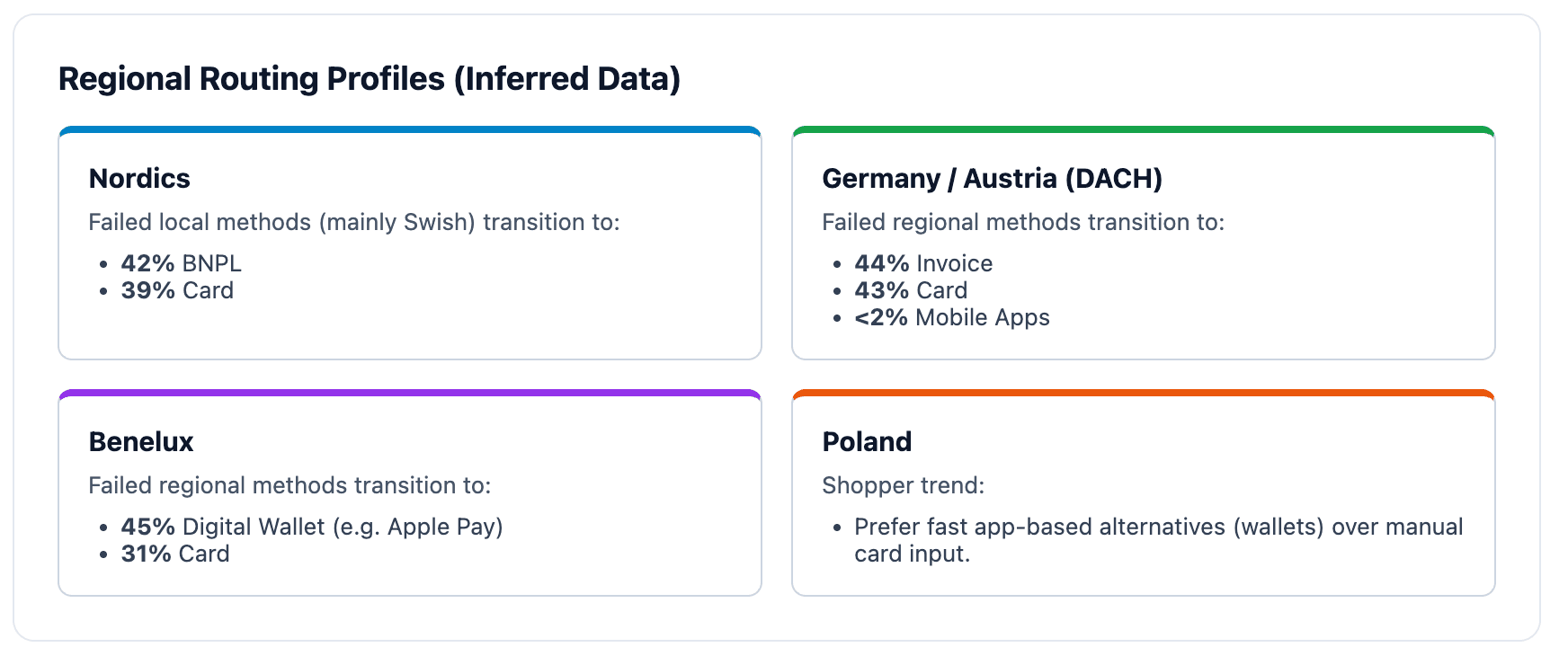
Nordics. This is by far the largest and most reliable regional read in the dataset. It mirrors the overall pattern closely: a failed Nordic-specific method (overwhelmingly Swish) is most likely to be followed by a successful BNPL payment (42%) or card (39%). This tracks with what national reporting on Swedish e-commerce has found more broadly too. PostNord's Nordic e-commerce report notes that invoice-based payment is uniquely prominent in Sweden compared with its Nordic neighbours, while Swish continues to grow in parallel as a preferred option, which is consistent with the tight BNPL-and-Swish loop we see in this data.
Germany/Austria (DACH). A more limited slice of the dataset, so we read this as directional rather than conclusive, shows a noticeably different shape. Failed attempts on this region's specific methods most often converted to invoice (44%) or card (43%), with almost no shift toward mobile payment apps (under 2%). That is a sensible outcome given that the market-specific instruments here are largely invoice and bank-debit style products rather than a dominant local mobile wallet, so there simply is not a Swish-equivalent for shoppers to fall back on.
Benelux. Also a more limited slice, but the shape here leans toward wallets: 45% of failed region-specific attempts converted to a wallet payment, most often Apple Pay, ahead of card (31%). Encouraging given how embedded wallets are in Dutch and Belgian checkout habits.
Poland. The most limited regional read we have, so we treat this as an assumption rather than a firm finding. With that caveat, the direction is consistent with what we see elsewhere in the data: most of these shoppers moved to another fast, app-based way to pay (a wallet) rather than switching to manual card entry, in line with the idea that shoppers in a market built around quick, redirect-style payments tend to reach for a similarly frictionless alternative first.
It is worth being explicit about why the Nordics dominate this dataset so heavily: Briqpay's own merchant base skews toward Nordic e-commerce, so this is a reflection of who we serve rather than a claim about payment behaviour in Northern Europe generally.
Across the whole dataset, the median time between a failed first attempt and a successful completion was just under two minutes (around 100 seconds). Invoice retries took a little longer to resolve (around 150 seconds median), which makes sense given that an invoice attempt typically involves an additional credit or identity check before a merchant can offer an alternative. Everything else clustered close to the overall average.
The takeaway for merchants: whatever alternative you want a shopper to see after a decline, it needs to be visible and selectable within seconds, not buried behind a reload or a new page. Shoppers are not spending minutes weighing their options; they are reacting almost immediately.
A few practical conclusions follow reasonably directly from the patterns above:
Offering only one type of fallback after a card decline captures a meaningful slice of shoppers, but the 24/22/20/19/15 split we saw across mobile payment, invoice, card, wallet and BNPL shows that a single fallback leaves real conversion on the table. A broader spread of payment types available at the point of failure, not just more card processors, is what actually recovers more of these sessions.
For merchants operating in the Nordics specifically, having both a strong BNPL option and a fast mobile payment method available is doing a lot of quiet work. Given how often shoppers swap between exactly these two, having only one of them in the checkout risks losing a shopper who would have completed with the other.
Invoice shoppers deserve their own fallback path. Because they are unusually likely to want to stay within the invoice category even after a decline, having a second invoicing or "pay later" option available (rather than routing everyone straight to card) will convert more of them.
This analysis is based on aggregated, anonymised checkout session data from a twelve month period, covering more than 31,500 completed retries across our merchant network. It captures only sessions that ultimately succeeded with an alternative method, not the shoppers who failed and left. Regional groupings are inferred from the public market association of specific payment methods and are clearly flagged as assumptions rather than confirmed geographic data. Where a sample size was small (Benelux, and especially Poland), we have said so explicitly rather than presenting it with the same confidence as the larger Nordic sample. No individual, order or merchant can be identified from any of the figures above.
Payment failure is never going to disappear entirely, cards expire, credit checks decline, sessions time out. What this data suggests is that the checkout that recovers the most revenue is not necessarily the one with the fewest declines, but the one that gives a shopper a genuinely different, fast, low-friction way to try again.
Failed-payment retries are one thread in a larger pattern: our full look at what actually reduces checkout costs and cart abandonment ties this together with payment switching, refunds and basket size.
A complete guide to payment gateways in Finland: Paytrail, MobilePay, cards, and B2B invoicing, and how to connect them all through one integration.
Black Friday 2026 lands seven days after CCD2 applies. We went back to our consumer checkout data from Black Friday 2025: a peak nine times a normal day, BNPL up six points in Sweden and the Netherlands, and a busiest hour of 22:00. Here is what to fix first.
commercetools makes best-of-breed payments possible but not automatic. Here is how payments grow connector by connector, what Connect and Checkout give you, and how an orchestration layer lets you add providers by market and customer type without new builds.
Connect any payment provider. Optimize your payment flow. Scale without limitations - with Briqpay’s Payment Integration Platform.
